

Accounting firms help clients manage tax obligations, yet coordinating and making payments can create an overlooked cost within the firm itself. That’s the hidden tax on independent accounting firms.
Tax season can be a draining crunch for any CPA or firm. Then comes the payment process.
Making or facilitating tax payments for clients is a frustrating drain on staff time, forcing already-stretched accountants to move between banking portals, various government systems, internal tools, and client communications. Even worse are the intermediary steps, like obtaining client approval for authorization, reconciling, obtaining proof of payment, and fixing any errors or complications that emerge during the process.
None of these costs appear on the balance sheet, but collectively they reduce firm capacity and profitability. Thankfully, there’s a remedy.
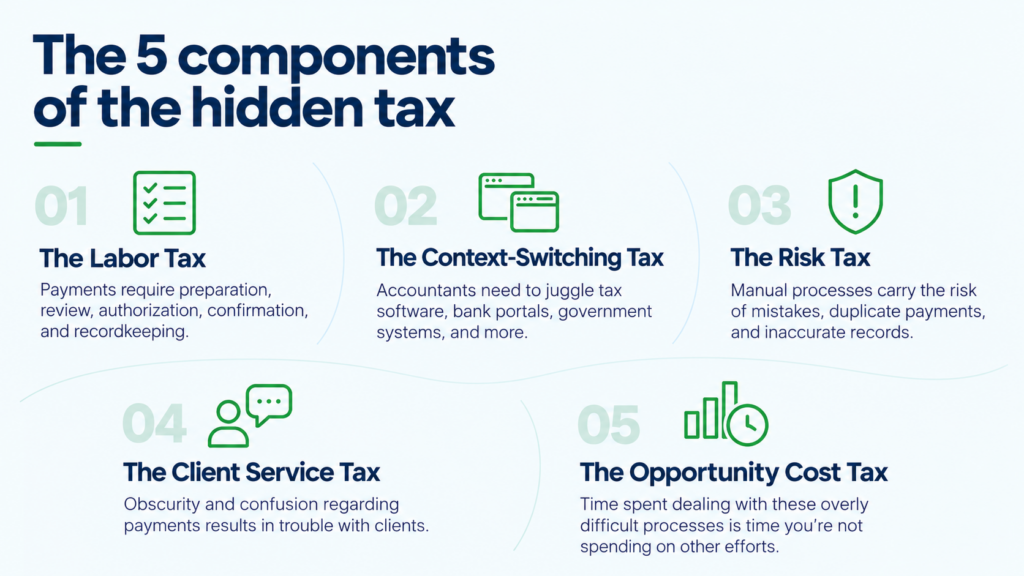
The five components of the hidden tax on accounting firms
Five issues arise from a disjointed payment system. These troubles affect your firm in several areas and can weigh it down in various ways.
The labor tax
Even after the bulk of the work on a tax return is done, the payment process still takes a lot of effort. Payments require preparation, review, authorization, confirmation, and recordkeeping. These processes require coordination within the firm and with the client. This takes time and energy that could go elsewhere, particularly toward new clients.
The context-switching tax
Jumping between different portals, platforms, internal tools, and software is a disjointed process. That stop-start approach to work interrupts focus and makes routine work more mentally demanding than it needs to be. That means your staff works harder and less efficiently.
The risk tax
When work gets harder, the probability of mistakes goes up. That’s especially true with manual record-keeping. One oversight can lead to duplicate payments, missed deadlines, inaccurate records, and angry clients. That means even more work for your team.
The client service tax
When the payment process is difficult and opaque, clients ask more questions and get more stressed. Not answering them strains the relationship between your clients and your firm, and increases the likelihood of churn. That means spending more time alleviating concerns and answering client questions throughout the process. This increases the time spent on an account and decreases the number of accounts your firm can handle.
The opportunity cost tax
If your team is doing extra paperwork, juggling different tools in their workflow, double-checking for errors, and reassuring clients, that’s time they could spend serving more clients and doing other work to boost your bottom line. While these don’t carry a clear dollar value on your balance sheet, they add up to a serious expense. Imagine how many more clients you could serve if you removed these inconveniences.
Independent accounting firms feel the burden the most
The burden of fragmented tax payment processes isn’t evenly distributed among accounting firms. Independent and mid-sized firms are hit the hardest by this hidden tax because they have less operational leverage to absorb those troubles.
Larger firms may have dedicated operations teams, proprietary payment software, or internal resources designed to alleviate the pressure of high-volume periods. Independent firms are more likely to rely on their own staff, or even partners, to handle parts of the payment process. All this comes alongside the core client work that supports the firm’s ongoing operations from year to year.
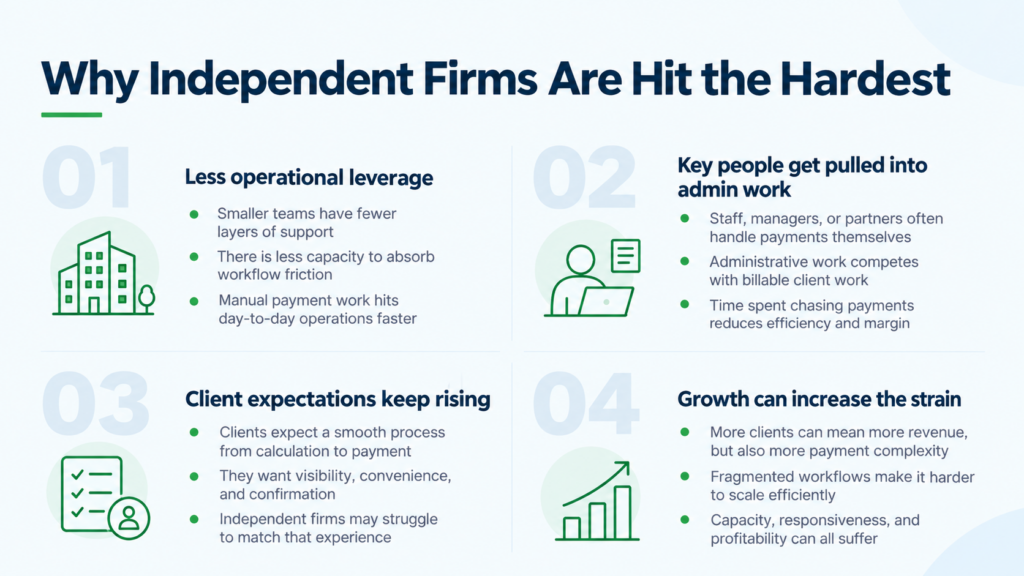
Meanwhile, client expectations are rising. Whether it’s a business or an average person, the expectation is a seamless experience from start to finish. The demand is for greater visibility, convenience, and support around the payment process itself. Once again, larger firms are well equipped to handle those troubles. Small and medium-sized accounting firms typically aren’t.
This creates a difficult dynamic for small firms: growth can increase revenue while worsening internal workflow issues.
The issue isn’t just that tax payments take time. The fragmented payment workflows make it harder for a firm to grow steadily. For independent firms trying to compete on responsiveness, expertise, and client experience, that hidden tax becomes a meaningful constraint on profitability and capacity.
ReverePay fixes the hidden tax
This is a major challenge that firms face, but there’s some good news. There’s a surprisingly simple solution: ReverePay.
ReverePay streamlines what is normally a frustrating, disjointed process into a simple one. Instead of asking the client to write checks to multiple revenue agencies, a check to you, and hoping they all arrive on time, ReverePay removes the uncertainty and frustration from the equation for both you and your clients.
Instead of a days-long process, ReverePay lets you give your client a single invoice. As a result, they can pay you and all the applicable revenue agencies at once.
This simplifies the process for both you and the client.
While this takes work off the plates of your tax professionals, it’s also likely to be a relief for clients. It’s no secret that tax season is stressful for the average person, and clients who find the final stages of tax season particularly burdensome to finish things each year will appreciate not having to go through that process again. It also improves your brand with clients, as you’ve lightened their workload during tax season as well.
Want to see if ReverePay is a good fit for your firm? Schedule a quick call with a member of our team to learn how ReverePay can remove that hidden tax and improve your client relationships.